
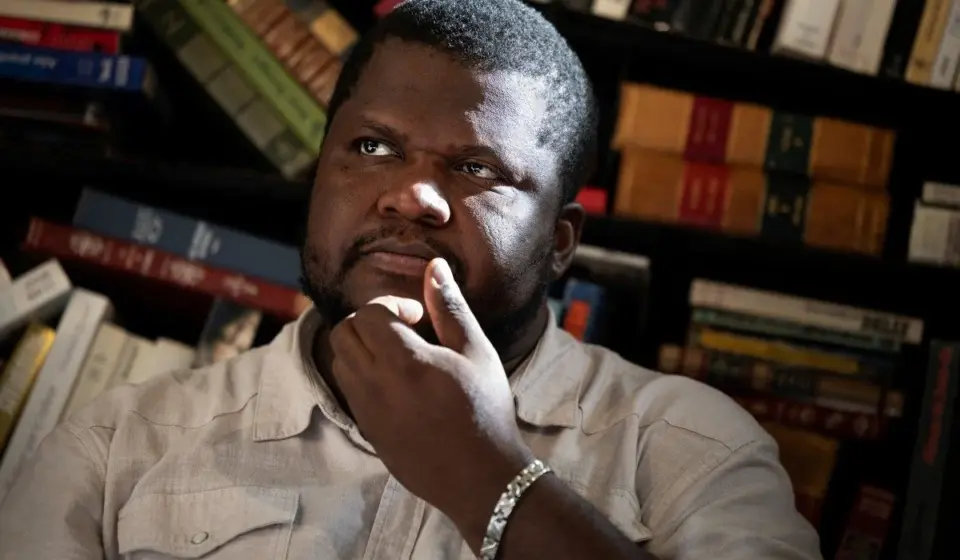

After several weeks of promotional appearances in France, Thélyson Orélien returned to Quebec over the weekend of September 26 and 27. His entourage confirmed to AFP on Monday, September 28, the interruption of his French tour, as his novel , *C’était ça ou mourir* (It Was That or Die) , is at the center of a controversy involving suspicions of artificial intelligence use and accusations of plagiarism. No specific reason has been given for his departure.
A tour interrupted amidst controversy
Having been in France since the beginning of September to promote his book, the author was scheduled to participate in events in Paris and other regions. He was notably present on September 24th at the Les Correspondances literary festival in Manosque. His return to Canada brings this schedule to an end, and his team has not yet provided details of his future commitments.
The book’s promotion was already disrupted in Quebec: Éditions du Boréal had suspended the Canadian tour on Thursday, September 24. The cancellation of the tour in France therefore comes at a time when the author’s public activities are being affected on both sides of the Atlantic.
A novel that went from success to suspicion
Published by Grasset on August 19, 2026, *It Was This or Die* tells the story of a Haitian migrant’s journey to Canada. Before the controversy erupted, the book had received the Fnac Novel Prize, announced on September 21, and was on the first shortlist for the Goncourt Prize. On September 25, it was withdrawn from the shortlist.
The accusations concerning the novel are based in particular on results attributed to the Pangram software, which claims to detect texts generated by artificial intelligence. These results have fueled suspicions, but do not, on their own, constitute proof of the conditions under which the book was written. In parallel, accusations of plagiarism concern texts published by Orélien in Quebec more than ten years earlier. These are two separate issues that have broadened the controversy beyond the debate surrounding detection tools alone.
A statement is still awaited.
So far, the author has not responded in detail to the accusations. In a statement reported by AFP last week, he said he wanted to speak « when things have calmed down » and believed the attacks were also targeting his voice. He also told Libération that he was the target of racist attacks. These remarks express his perspective on the controversy; they do not resolve the accusations themselves.
The return to Quebec thus marks a pause in the writer’s public presence, but does not put an end to the questions surrounding the book. What happens next will depend in particular on his statements and the evidence presented in both cases. For the time being, it is important to distinguish between accusations, editorial decisions, and established facts, without confusing a media controversy with a definitive conclusion.
Main source: 20Minutes – Culture News (www.20minutes.fr)
Original article: See the original source
Author: 20 Minutes with AFP
Additional sources