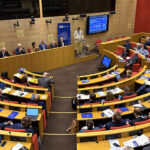



Gathered at the Luxembourg Palace for the 30th anniversary of the Institute for Delegated Management (IGD), some 140 participants debated the best way to en quality public services at a controlled cost. Without pitting public management against delegated management, the discussions also highlighted two key issues: maintaining sufficient competition in calls for tenders and improving contract preparation.
A management method, not a privatization.
Delegated management involves entrusting a company with the operation of a service, certain technical activities, the financing of investments, and a share of the operating risk. The service provider is paid by the users, sometimes with a contribution from the local authority.
For those involved, this system is not intended to replace direct management. The local authority remains responsible for the service: it sets the objectives, chooses its contractor, and monitors the contract’s execution. The president of the IGD, Hubert du Mesnil, reiterated that « delegating does not mean privatizing. » The white paper published by the Institute on its anniversary also emphasizes this distinction.
The question posed at the conference—which management method guarantees the best service at the best cost?—is situated within a context of constraints on public finances and investment needs for local authorities. The IGD advocates a case-by-case approach, rather than a blanket choice between direct management and delegation.
More closely monitored contracts, but fewer candidates
In the water and sanitation sectors, Estelle Grelier, president of the French Federation of Water Companies (FP2E), emphasized that concession contracts must now incorporate the challenges of energy conservation and adaptation to climate change. Climate risks can jeopardize the economic viability of long-term concessions, leading public and private stakeholders to re-examine risk sharing.
Delegated management also applies to highways and several railway infrastructures. Fabrice Franck, representing Keolis, indicated that nearly 80% of French transport networks are operated using this model. He described contracts that include performance indicators, incentive mechanisms and penalties, as well as monitoring and reporting tools for local authorities.
But the increasing complexity of the procedures can restrict competition. Frédéric Marty, research director at the CNRS, reported an increase in the proportion of calls for tenders receiving only one response, rising, according to him, from 23% in 2024 to 41% in 2025. Notices of concession awards published in 2022 and 2023 also show slightly fewer than two bids on average, with only one bid in more than a third of cases.
Frédéric Marty attributes this situation more to technical, financial, and legal requirements than to a lack of interest from companies. He warned that insufficient competition could negatively impact prices and the capacity for innovation.
The preparation of the contracts in question
The quality of preparation also emerged as a determining factor. Anne-Sophie Orecchini, Deputy Managing Director of Finance Consult, emphasized the need to clearly define requirements, en transparency, and maintain dialogue between partners. She also mentioned review clauses, which allow contracts to be adapted to economic or climate-related changes.
The discussions addressed the legal concerns surrounding global contracts and partnership agreements. Sophie Nicinski, professor of public law at Paris 1 Panthéon-Sorbonne University, believes that certain misconceptions continue to influence their assessment, notably the association of deferred payment with budgetary overruns or the difficulties related to the duration of these contracts. She also noted confusion surrounding the concepts of project owner and project management.
In its white paper, the IGD (General Inspectorate of Infrastructure) puts forward ten proposals to improve the efficiency of public services. These include better statistical monitoring, more thorough sourcing before tendering, and a more balanced sharing of risks. The document also recommends strengthening the skills of public procurement officers, developing training programs, and increasing support for local authorities from Fin Infra (the French infrastructure research and development agency). Finally, the Institute advocates for more flexible contractual frameworks and better consideration of different management methods, without excluding any in principle.
Source: Localtis News – Caisse des Dépôts Group – Public Procurement (www.banquedesterritoires.fr)
Original article: See the original source
Author: Virginie Fauvel