
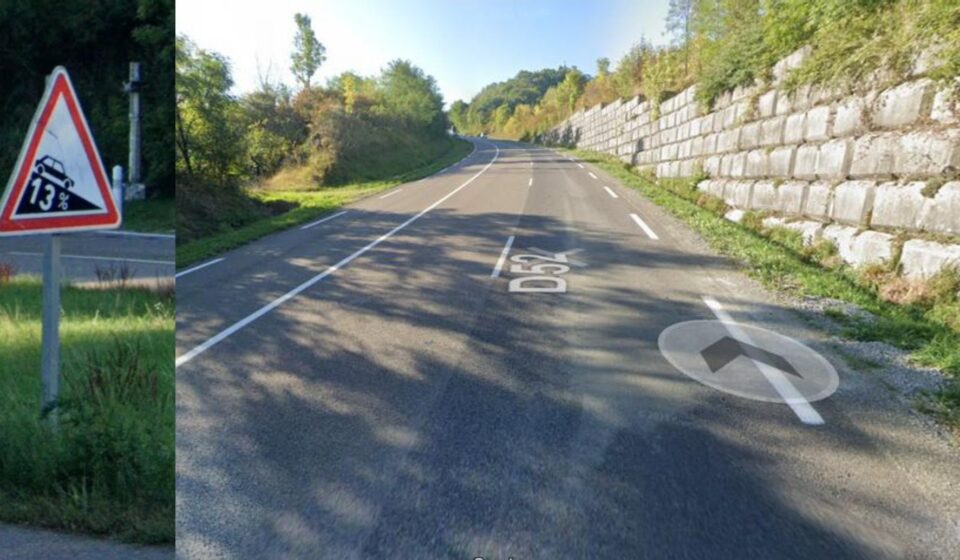
In the Jura region, a single lane has been chosen to secure the descent from Montaigu for heavy goods vehicles.

On the RD52, the steep descent from Montaigu makes it difficult for heavy goods vehicles to pass and diverts some traffic through the Vallière valley. At the request of the Jura Department, Cerema identified a potential risk in the development project: maintaining the intersection with Rue de l’Echenaud could have left cars stuck in the truck lane. An alternative solution was chosen, but the new truck lane is not yet open.
A steep descent and a detour for trucks
The RD52 connects the plateau south of Lons-le-Saunier via the Montaigu hill, within the municipality of Montaigu. According to Cerema, the gradient reaches 13% over nearly a kilometer. To limit the risk of brake overheating, heavy goods vehicles weighing over 19 tonnes are currently prohibited from using the descent. Approximately 350 trucks per day, on average annually, therefore use the RD678 and the Vallière valley, passing through several villages.
The Jura Department, responsible for the road, studied the possibility of reopening the RD52 to heavy goods vehicles with safety improvements. The initial project included a mandatory stop before the incline, a speed limit of 40 km/h, emergency stopping lanes, and separate lanes for trucks and cars.
The Echenaud crossroads, a blockage point
Cerema carried out a technical review of the project: geometry, visibility, signage, safety barriers, and the sizing of the stopping beds. It also examined the conditions necessary to maintain the intersection of Rue de l’Echenaud, located near the roundabout at the bottom of the slope.
The problem is concrete: from this intersection, cars could have entered the lane reserved for trucks just as the trucks were reaching the bottom of the slope, in an area likely to be slowed down by the roundabout. According to Cerema’s analysis, motorists could have found themselves with no way out. Adding equipment alone would not have been enough to eliminate this risk.
The consulting firm therefore proposed revising the operation of the lower section of the project: after the first run-off area, all vehicles would be grouped onto a single lane. This configuration would allow the intersection to be maintained and the existing run-off area, visible from the downhill slope, to be reused. However, traffic flow for all vehicles would be slowed on this final section.
Work has begun, but the opening is planned for 2027.
The Department approved the recommended solution, according to Cerema. Departmental decrees published in January 2026 govern the construction work on the dedicated lane on the RD52. In September 2026, the Department indicated that the road had been reopened after a phase of construction, with two uphill lanes and one downhill lane; it announced at that time that trucks could once again ascend the hill. The opening of the new downhill lane dedicated to heavy goods vehicles was scheduled for autumn 2027.
For the residents of the villages in the Vallière Valley, the goal is to reduce the disruption caused by the detour for heavy goods vehicles. However, the benefit will depend on the actual implementation of the project and the conditions under which trucks can use the descent. The available information does not specify the total cost of the project.
Key points to remember
- The RD52 descends the Montaigu hill, with a gradient of 13% over almost a kilometer.
- According to Cerema, approximately 350 heavy goods vehicles weighing over 19 tonnes per day are currently taking the detour via the RD678.
- Maintaining the Echenaud intersection led to a review of the project to prevent cars from getting trapped on the truck lane.
- The Department announced an opening of the dedicated lane in the fall of 2027; no amount of work is indicated in the sources consulted.
Main source: Cerema – News (www.cerema.fr)
Original article: See the original source
Author: Cerema
Additional sources