High school student mobilization: Mélenchon accuses the Lecornu government of repression

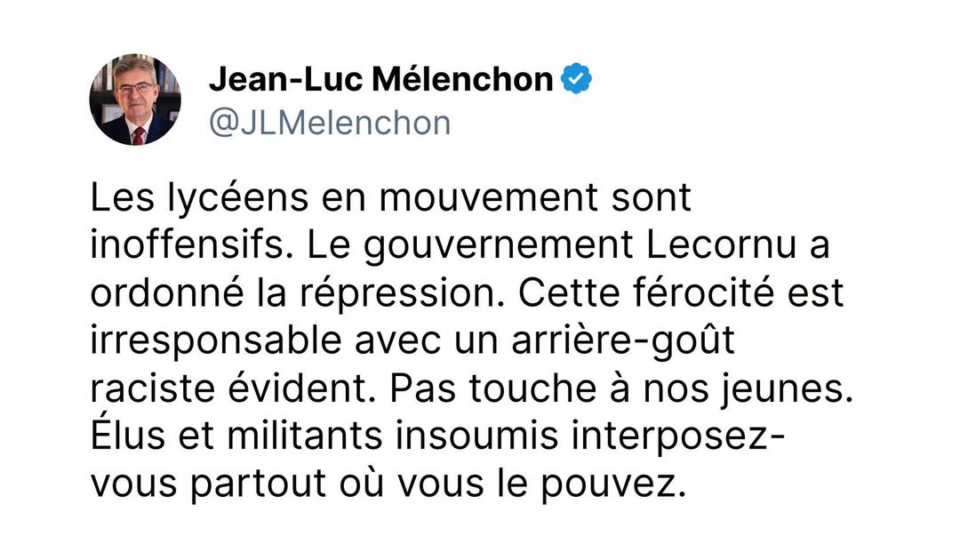
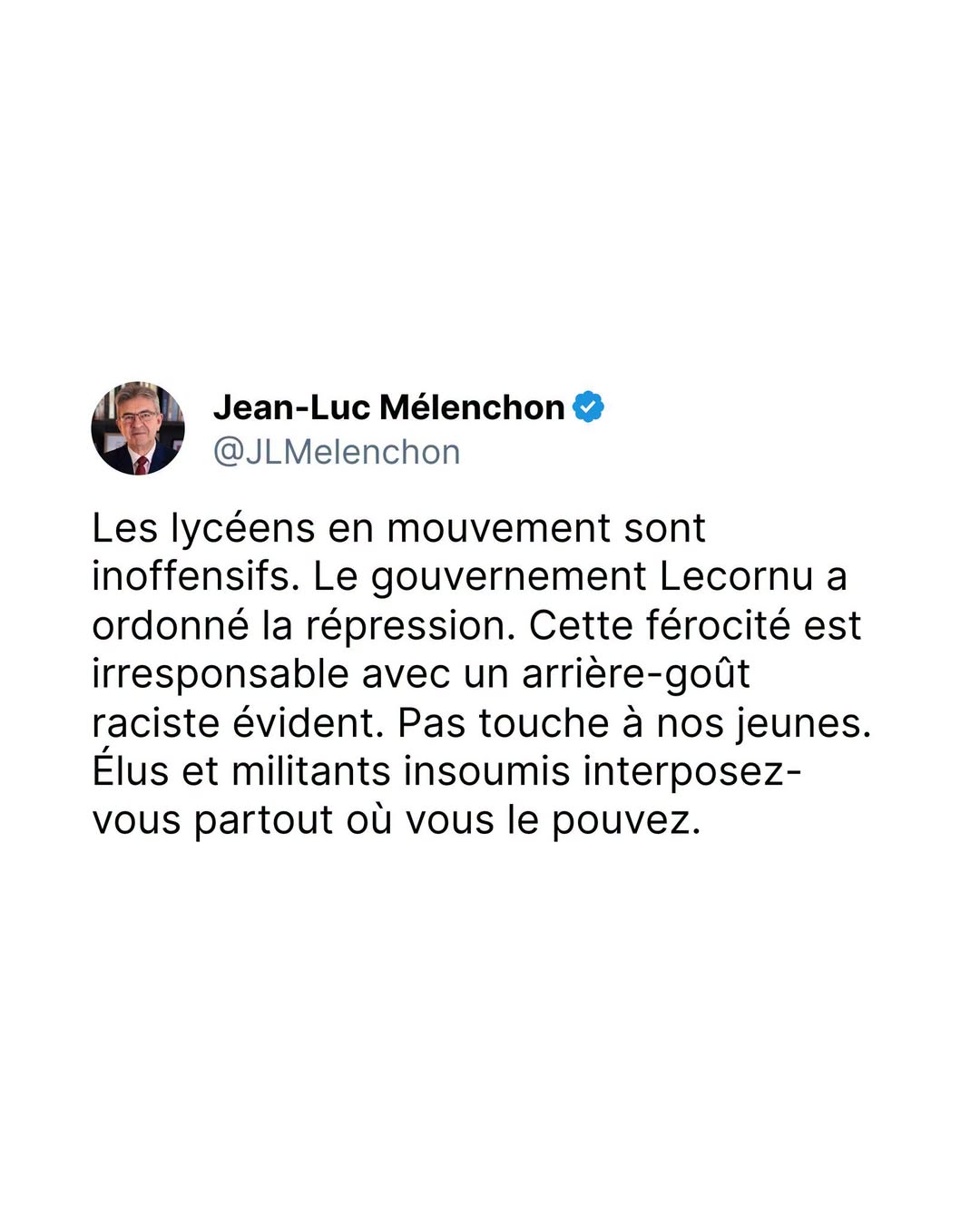
The student protesters are harmless. The Lecornu government has ordered repression. This brutality is irresponsible and has a clear racist undertone. Hands off our youth! Elected officials and members of La France Insoumise, intervene wherever you can.
Jean-Luc Mélenchon accuses the Lecornu government of having repressed the high school student mobilization and attributes a « racist undertone » to its actions. On September 28, 2026, his attack comes as high school blockades lead to incidents and the government criticizes members of La France Insoumise (France Unbowed) for encouraging the movement. Two questions intersect: what are the students demanding, and what is known about the police interventions?
The main fact
In a message attributed to Jean-Luc Mélenchon, the leader of La France Insoumise asserts that the protesting high school students pose no danger, accuses the government of ordering their repression, and calls on elected officials and activists within his movement to intervene when possible. This is a political accusation , not a government order established solely by the message.
For his part, Prime Minister Sébastien Lecornu denounced the « irresponsible bidding war » by elected officials from La France Insoumise who are calling for the blockades to be extended. He cited the firing of fireworks mortars, arson, and violence near schools.
What happened
High schools in the Île-de-France region have been experiencing blockades since the week preceding September 28th. The mobilization focuses primarily on study conditions and a lack of resources. In a press release published on September 27th, a coalition of education unions in Seine-Saint-Denis supports these demands and, for its part, denounces police violence and arrests. These statements alone do not allow for a complete reconstruction of each incident.
The controversy has taken on a national dimension: the debate no longer focuses solely on the state of the high schools, but also on security outside their gates and the response of law enforcement. It is precisely here that the two narratives diverge.
The context
High school students have freedom of expression and assembly, governed by the education code and school regulations. These rights do not make violence acceptable; conversely, incidents near some high schools are not sufficient to characterize all mobilized students as violent.
What the facts show
Mélenchon’s approach presents the « protesting » high school students as a harmless group. Lecornu’s emphasizes dangerous acts. However, the students’ demands and the existence of incidents can be true simultaneously. Confusing the two avoids addressing the former; ignoring the latter protects no one.
The evidence reviewed does not establish that an order to indiscriminately repress high school students was given, nor does it demonstrate the racist motive attributed to the government by Mélenchon. It also does not allow for the conclusion that any police intervention was justified. To judge this, it would be necessary to examine the facts, the instructions, and the specific circumstances of each location.
Key takeaways
The political standoff is well-documented. So are the difficulties reported in high schools. Between accusations of repression and pronouncements of firmness, the decisive verification remains to be carried out on a case-by-case basis. It cannot be contained in a slogan or a press release.
Source: Jean-Luc Mélenchon