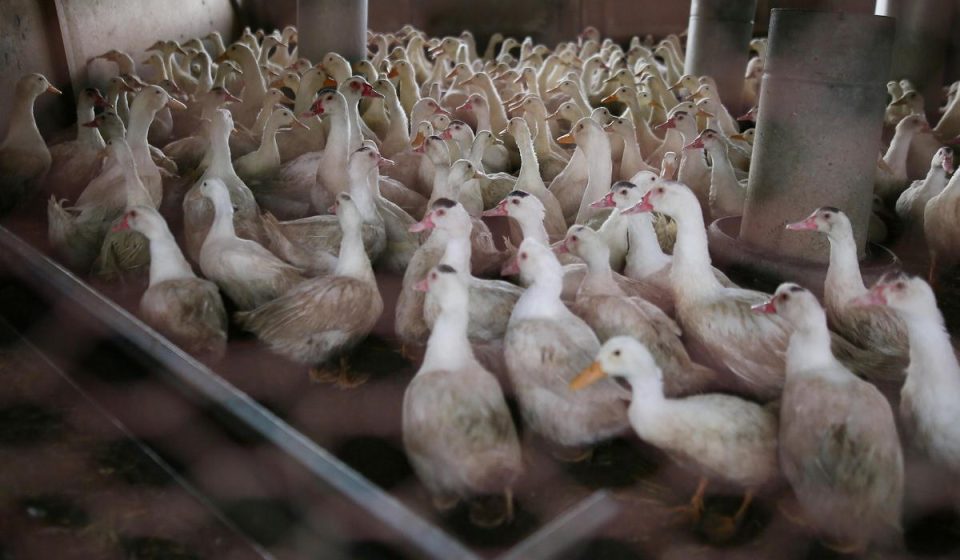
Bird flu: it’s true, chickens kept by private individuals can be infected, even in cities.

Can a city pigeon contract avian flu? Yes, although infections appear rare and available data do not indicate that pigeons are significant vectors of the H5N1 virus. It is the difference between « can be infected » and « commonly spreads the virus » that needs to be verified.
The claim has been verified
In an excerpt from a Sud Ouest article presented as published on December 5, 2025, the statement « Bird flu can infect urban pigeons » receives the response « FALSE (but.). » The text then specifies that these birds are relatively resistant to H5N1, while acknowledging that they can occasionally be infected. The verifiable statement here concerns the possibility of infection , not the frequency of cases or the risk to passersby. As the original page could not be accessed directly during this verification, the wording and date are those of the content provided with the request.
What the facts show
Infection is possible. A field study published in 2014 describes the isolation of a highly pathogenic H5N1 virus in a domestic pigeon of the species Columba livia in Egypt. This pigeon was not identified as a street pigeon: the case therefore demonstrates that the species can be infected, without, on its own, establishing the frequency of infections in French cities. ( pubmed.ncbi.nlm.nih.gov )
The relative rarity of the phenomenon is also supported. In a British assessment based in particular on the monitoring of wild birds, authorities identified 11 rock doves ( Columba livia ) among the cases reported in Great Britain since October 1, 2022. They emphasize that reports of highly pathogenic avian influenza in pigeons and doves remain few in number compared to their abundance. However, these detections do not constitute an infection rate for all pigeons: not all birds are tested. ( assets.publishing.service.gov.uk )
The verification
An experimental study published in September 2025 adds another piece to the puzzle. Researchers exposed Columba livia pigeons to an H5N1 strain from clade 2.3.4.4b. Only those receiving the highest dose showed some biological signs of infection; viral shedding was low, and no transmission was observed to pigeons or chickens placed in contact with them during the experiment. The authors conclude that the strain exhibits low susceptibility and limited transmission capacity under the studied conditions . An experiment without observed transmission does not prove that all transmission is impossible, everywhere and with all strains. ( pubmed.ncbi.nlm.nih.gov )
The shortcut, therefore, lies in the label « false. » If the question were « Are urban pigeons a major driver of the epidemic? », the evidence examined would suggest that this seems unlikely. But to the question « Can they be infected? », the documented infections preclude a « no » answer. This does not mean that a single pigeon encountered in a public square represents, in itself, an established danger to city dwellers. For the general population, Public Health France assessed the risk associated with the H5N1 strain studied as low in its analysis of November 10, 2025. ( assets.publishing.service.gov.uk )
Sources and data
The review distinguishes three types of evidence: a case of natural infection in Columba livia , reports from British surveillance, and an experiment measuring the susceptibility and transmission of a specific strain. None of these allows for calculating the probability that a given pigeon in a French city will be infected. ( pubmed.ncbi.nlm.nih.gov )
Verdict
Verdict: Relevant. The proposition that avian influenza can infect pigeons is valid; simply stating « false » is too categorical. However, the data supports the nuance developed in the original article: infections appear infrequent, and the role of pigeons in the spread of the studied H5N1 strain seems limited. ( pubmed.ncbi.nlm.nih.gov )
Key takeaways
« Unlikely to be infected » does not mean « impossible to infect. » When faced with a sick or dead wild bird, the French Office for Biodiversity recommends not handling it and reporting the discovery to the relevant departmental service or the hunters’ federation. ( ofb.gouv.fr )
Main source: The truth and the lies (www.sudouest.fr)
Original article: See the original source
Sources of verification
- Study on a natural H5N1 infection in a Columba livia pigeon, 2014
- Experimental study on the susceptibility and transmission of H5N1 in pigeons, 2025
- UK assessment of the risk of avian influenza at bird gatherings, 2025
- Public Health France, risk analysis of November 10, 2025
- French Office for Biodiversity, information on avian influenza