
Donald Trump and several executives from major American technology companies signed a voluntary pledge on AI security on Tuesday, September 29. The president presented it as « morally binding » and defended the sector’s self-regulation. However, the text provides for neither public oversight nor legal obligations, according to reports from several media outlets.
A commitment based on internal my
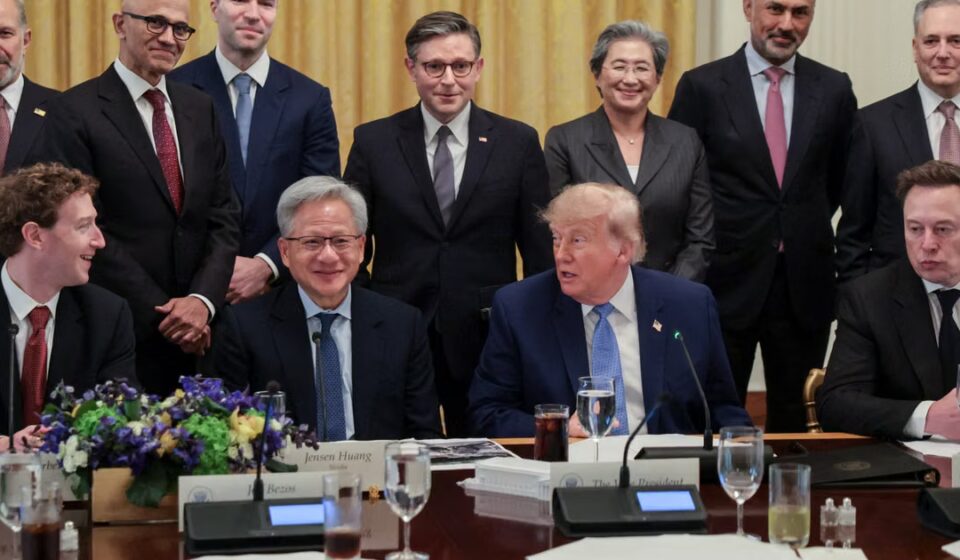
Gathered at the White House for a closed-door luncheon, Dario Amodei of Anthropic, Jensen Huang of Nvidia, Mark Zuckerberg of Meta, and Elon Musk of Grok were among the executives present. Donald Trump announced that they had signed a declaration aimed at strengthening the security of AI technologies.
The document relies on voluntary principles: companies commit, in particular, to establishing internal controls over the development of their models, to organizing external assessments, and to informing their boards of directors of the meas taken. The American president compared the agreement to a form of constitution and stated that it could protect the public while allowing companies to self-regulate.
This presentation, however, does not constitute a binding regulatory framework. According to The Guardian , the agreement does not include any monitoring mechanism or legal consequences for non-compliance. The text also reportedly does not assign any role to public authorities in the evaluations and does not require the publication of their findings.
Guarantees left to the discretion of the companies
Companies could also choose their own assessors, define their oversight bodies, and decide whether to make the results public, reports the British daily. These arrangements therefore leave the companies concerned with considerable leeway in deciding how to implement and en the transparency of their commitments.
The compromise allows the White House to address growing concerns about the risks of AI without announcing new mandatory rules for the sector. Politico sees this as a sign that the Trump administration is taking public concerns into account. The Wall Street Journal , for its part, highlights the continuation of the president’s lenient approach, despite calls for more regulation.
Differences put aside during lunch
The public scene at the White House did not reveal the disagreements within the industry regarding the pace of AI development. Yet, according to the Washington Post , some executives present, including Elon Musk and Dario Amodei, had recently called for slowing down this development.
When a reporter asked executives whether they believed the sector could manage without government protections, Donald Trump answered for them, the newspaper reports. He then gave the floor to Jensen Huang, who had opposed calls for a coordinated slowdown. The announced agreement thus relies on the voluntary commitment of companies, while the question of binding public oversight remains open.
Source: Courrier international – News from France and around the world, videos, infographics (www.courrierinternational.com)
Original article: See the original source