

Tourist accommodation occupancy increased in France during the summer of 2026, but the increases were significantly greater on several northern and western coasts than on the Mediterranean coast. Published on September 29, 2026, the INSEE figures presented by Ouest-France also show a decline in the southern Atlantic coast, affected by wildfires.
A moderate national increase, with marked differences depending on the coast.
Tourist group accommodations — hotels, campsites and other structures — recorded 260.5 million overnight stays between the 2025 and 2026 seasons, representing a 1% increase nationally.
This growth was more pronounced along the North Sea, English Channel, and northern Atlantic coastlines. According to data reported by Ouest-France, their growth was four to five times higher than the national average.
Conversely, the increase in overnight stays on the Mediterranean coast was half the average. This contrast suggests a shift in visitor numbers towards the northern coasts, although these figures alone are insufficient to explain the individual choices of each vacationer.
Heat and fires are contributing factors.
The French National Institute of Statistics and Economic Studies (INSEE) describes the summer as marked by heat waves. Ouest-France reports that these temperatures may have prompted some vacationers to seek cooler destinations in the northern half of the country. This is an interpretation of observed trends, and not a direct reflection of tourists’ motivations.
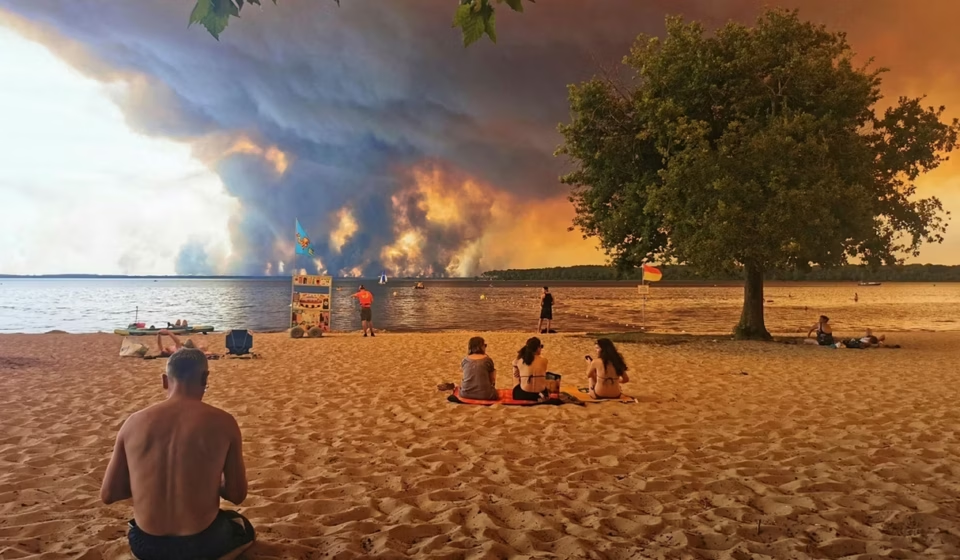
In the southwest, fires, particularly in the Gironde region, are also cited as a possible factor in the decline. The southern Atlantic coast is the only area mentioned where hotel and campsite occupancy decreased between the 2025 and 2026 seasons: it fell by 2.8%.
The data therefore reveals contrasting trends: an increase in occupancy rates in group accommodations nationwide, stronger increases on certain northern and western coasts, and a decline in the southern Atlantic coast. However, it does not allow us to quantify the respective contributions of the heatwave and the fires to these changes.
Source: Ouest France.fr – Live, continuous news updates and images (www.ouest-france.fr)
Original article: See the original source