
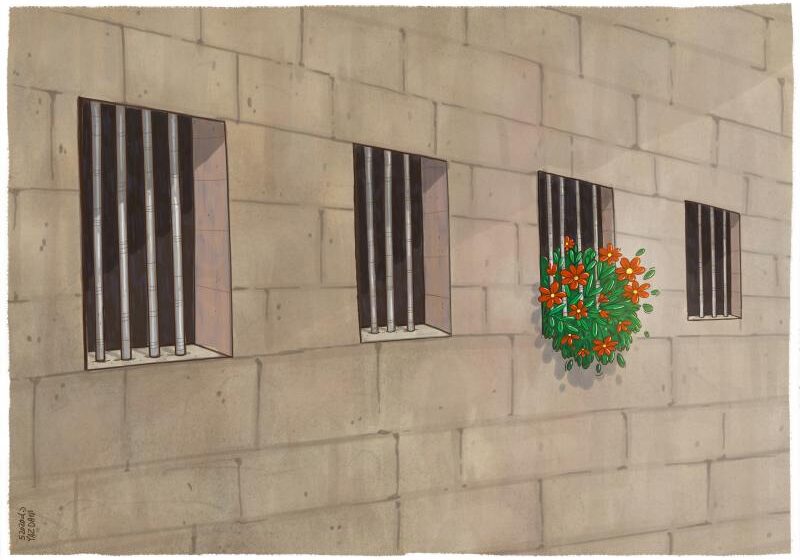

In Belgium, magazines, radio programs, and newspapers created with incarcerated individuals offer a glimpse into prison life from the inside. These media provide a space for creativity and reflection, but they face constraints inherent to prison life: limited access to tools, lack of time and resources, and the mobility of participants.
Writing and creating behind walls
In the 26th issue of Oxygène , Belgian prisoners respond in prose or poetry to questions about forgiveness, truth, and second chances. This magazine is published twice a year in partnership with Adeppi, the Continuing Education Workshop for Incarcerated Persons.
Literary texts, drawings, reports produced in prison, and recipes all appear side by side. For Camilla and François, who coordinate the publication for Adeppi, Oxygène is first and foremost a newspaper for inmates, produced with their input. Born from a lifelong learning initiative, it has developed its structure over time while retaining, according to its editors, a flexible, fanzine-inspired format.
Other publications, such as Le Yoyo , Libre Marche , and Hubert Mag , also recount daily life in detention. On the radio, the program Le Cri , produced with GSARA and the Foundation for Moral Assistance to Prisoners, addresses issues such as overcrowding, health, and access to culture.
In Belgium, access to television, print media, and radio is permitted but regulated. In particular, detainees must pay for their television sets, subscriptions, and newspapers. Internet access is provided through a platform that grants access to certain secure websites, and these access points may be restricted for security reasons.
A media outlet for prisoners, or beyond the walls?
The question of the public divides approaches. In France, L’Envolée , published since 2001 by former prisoners and their families, disseminates letters, trial reports, and analyses to voice the demands of incarcerated individuals. The International Observatory of Prisons, for its part, publishes the journal Dedans-Dehors , produced by volunteers in collaboration with prisoners and their families.
In Spain, La Voz del Patio is produced by inmates at the Burgos penitentiary with the help of media professionals. Printed since 2019, it is distributed in shops throughout the city and within the Spanish prison system. Its coordinator, Víctor Cámara, presents this distribution as a way to contribute to the reintegration of people marginalized by society.
Oxygène favors a different approach: its editors believe the magazine must remain primarily a platform for incarcerated individuals to express themselves. They fear that the prospect of being read outside the prison would curtail their freedom of speech. They also explain that dissent has its place in the publication, within the legal framework of the prison, and state that they have not had to make any contributions.
In Italy, the magazine L’Alba , created by inmates at Ivrea prison, has faced restrictions. In 2023, its director made the continuation of its activities conditional on the publication of unsigned articles and their prior review, with the possibility of removing those deemed inappropriate. In April 2025, more than twenty Italian prisoner-run magazines wrote to the Ministry of Justice to defend freedom of expression and request, among other things, better access to digital technologies.
Projects weakened by detention conditions
These media outlets often rely on associations and volunteers, but their operations are hampered by a lack of resources and time. Transfers between institutions complicate project continuity, while limited internet access restricts research and production opportunities.
These obstacles are part of a Belgian system facing severe overcrowding. The Central Prison Oversight Council indicated that as of March 31, 2025, more than 13,700 people were detained or on extended prison leave for 11,040 available places, representing an occupancy rate of 124%. It also warned of the effects of this situation on living conditions, access to healthcare, and reintegration opportunities.
Mental health is another fundamental issue. Based on data available in fifteen European countries, the World Health Organization estimated that approximately one-third of incarcerated individuals suffered from mental health disorders. Spaces for creation and sharing do not replace treatment, but they provide a platform for experiences and concerns that often remain largely invisible outside prison walls.
Source: Voxeurop (voxeurop.eu)
Original article: See the original source
Author: Adrian Burtin