

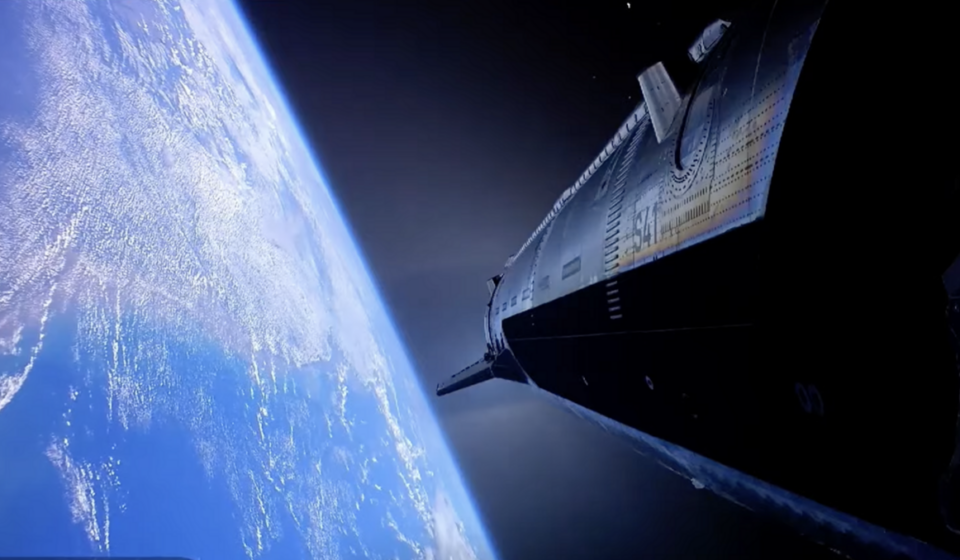

On September 28, 2026, Starship reached Earth orbit for the first time and deployed 26 Starlink V3 satellites. But after the premature shutdown of an engine during the ascent, SpaceX shortened the flight: the spacecraft splashed down in the North Pacific a little over three hours after its takeoff, instead of the planned ten hours.
A first orbital launch despite an engine failure
The 124-meter rocket lifted off from Starbase, Texas, at 7:48 a.m. local time, or 2:48 p.m. in Paris. Its first stage splashed down in the Gulf of Mexico. The Ship 41 spacecraft, however, continued its ascent despite the failure of one of its Raptor Vacuum engines.
Starship then reached an orbit approximately 275 kilometers above the Earth. This achievement marks a significant step forward compared to previous flights, which followed suborbital trajectories. SpaceX had aimed for a mission lasting about ten hours and six orbits of Earth, but the company chose to bring the spacecraft back earlier. ( spacex.com )
The decision was made as a precaution after the engine problem. The return took place north of Hawaii, in the Pacific Ocean, at approximately 5:58 p.m. Paris time. Starship burst into flames after hitting the water. SpaceX indicated that this outcome was expected: the spacecraft is not designed to float in cold water. The company nevertheless declared the flight a success, as the two main objectives of the mission had been achieved.
26 Starlink V3 satellites deployed
This flight also served to transport an operational payload. The 26 Starlink V3 satellites were released from the Starship cargo bay. According to SpaceX, each one is expected to add 1 terabit per second of capacity to the constellation. The company presents this capacity as ten times greater than that provided by a Falcon 9 loaded with V2 mini satellites.
Three satellites were equipped with cameras pointed at the spacecraft to photograph its thermal tiles. These images are intended to contribute to the study of the heat shield, an element that engineers modified after inspecting a recovered Starship in July. The changes mentioned include reinforced fasteners and curved tiles. Two recovered tiles were also flown aboard Ship 41.
An early return rather than a full trial
This caution is also explained by the risks of an orbital flight. During previous tests, the planned trajectories directed the spacecraft toward designated splashdown zones. In orbit, a loss of control could lead to reentry over an inhabited area. The mission’s shortening therefore limited the time spent in orbit after the engine incident, without allowing for the full initially planned duration.
The next step announced by Elon Musk is an attempt to catch the spacecraft with the launch tower arms during flight 15. The result of the Ship 41 flight, including observations of the heat shield, is among the elements to be examined before the next stage of the program.
Source: Les Numériques – All the latest news, reviews and features, and great deals in the Science & Space category (www.lesnumeriques.com)
Original article: See the original source
Author: Aymeric Geoffre-Rouland