
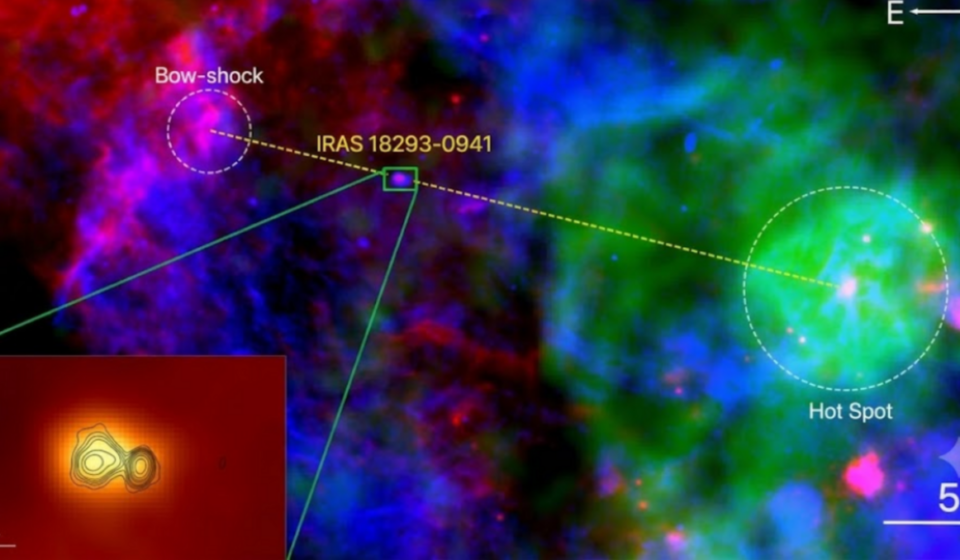

The binary system IRAS 18293-0941, located approximately 12,000 light-years away in the Milky Way, is presented as the first microblazar identified in our galaxy. It associates a massive star with a black hole from which two jets of matter are hurtling at nearly 225,000 km/s. One of them is oriented almost directly towards Earth, but poses no threat at that distance. ( api.uva.nl )
A system known for decades
IRAS 18293-0941 is not a new celestial object: it was already listed in the IRAS catalog in 1983. Its particular interest was only highlighted after researchers noticed its compact and luminous nucleus, which appeared to emit a jet. Observations in several domains—radio, X-ray, and gamma rays—subsequently allowed for the study of the system.
It consists of a massive, hot star orbiting a black hole of about ten solar masses. Their orbital period is less than twelve days. The black hole attracts matter which forms an accretion disk around it; two jets are ejected from this region in opposite directions.
According to observations reported by researchers, these jets reach approximately three-quarters of the speed of light, or about 225,000 km/s. One of them points almost directly towards Earth. However, the 12,000 light-year distance separating the system from our planet indicates that the jet poses no danger to the biosphere.
A first on the scale of the Milky Way
Astronomers are already familiar with blazars, the nuclei of distant galaxies whose jets are directed towards us. IRAS 18293-0941 appears to be a similar phenomenon, but on a much smaller scale: the black hole is located in a binary system within our galaxy, rather than at the center of a distant galaxy. This type of object is called a microblazar.
The existence of microblazars had been theorized for about thirty years, but no case had yet been confirmed by observation. The discovery was announced on September 22, 2026. It offers researchers the opportunity to study in more detail a system of this type, closer to our own than known extragalactic blazars.
The jet’s power also appears to have left its mark on its surroundings: according to observations cited in the study, it swept across a region approximately 100 light-years across. The system is thus described as a natural particle accelerator. This perspective contributes to the scientific interest of the discovery, without altering the fact that the phenomenon occurs at a very great distance from Earth.
Benito Marcote, co-author of the study, points out that observing an analogous object in our galaxy allows us to examine the physics of blazars in more detail than for their distant extragalactic equivalents.
Source: Les Numériques – All the latest news, reviews and features, and great deals in the Science & Space category (www.lesnumeriques.com)
Original article: See the original source
Author: Brice Haziza