
COP17: Mongolia expands its partnerships without distancing itself from China and Russia

Mongolia is seeking to leverage its position between Russia and China as a diplomatic tool. The COP17 climate conference on combating desertification, held in Ulaanbaatar in August 2026, allowed it to highlight its pastoral challenges and mobilize external partners. However, this opening does not diminish the influence of Beijing and Moscow in its economic and energy relations.
Desertification: A National and Diplomatic Issue
Approximately 77% of Mongolia’s territory is degraded to varying degrees, according to data from the United Nations Convention to Combat Desertification. The consequences directly affect livestock farmers: droughts and extreme winters, known as dzud , can decimate herds and jeopardize rural employment. Ulaanbaatar now concentrates nearly half the population, amidst a mass exodus to the capital.
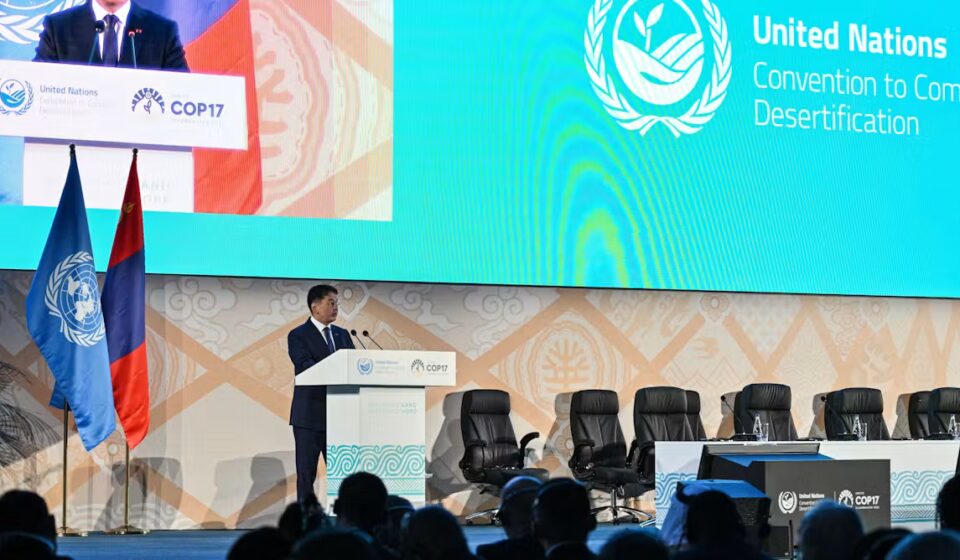
Mongolia has made these challenges a central focus of its diplomacy. After successfully advocating for 2026 to be declared the International Year of Rangelands and Pastoralists, it hosted COP17, which placed rangelands at the heart of discussions on land restoration. The conference announced a $1.3 billion portfolio for projects in 23 countries. However, a significant portion of this funding remains to be disbursed: the UNCCD has identified $644.5 million in new funding and indicates that $216.4 million is confirmed and in the process of being implemented.
Visibility despite stalled negotiations
COP17 brought together approximately 25,000 participants, the largest international event held in Mongolia since the 2016 Asia-Europe Meeting (AEMM) summit. However, negotiations to establish an international instrument on drought failed to produce results. Several African delegations advocated for a binding protocol, which the United States opposed. The issue has been deferred to COP18, scheduled for 2028 in Sharm el-Sheikh.
The outcome is therefore mixed: little progress on the negotiated text, but an international platform for Ulaanbaatar. Hosting a conference allows Mongolia to present its initiatives, including the « One Billion Trees » campaign, and to showcase its expertise on the steppes and pastoralism.
Expanding partnerships without distancing ourselves from our neighbors
This strategy extends Mongolia’s « third neighbor » doctrine, which involves developing ties with partners beyond Russia and China: the United States, Japan, South Korea, India, and the European Union. The emphasis now also places on concrete cooperation in the areas of climate, minerals, and infrastructure. The goal is to diversify funding and relationships without causing a rift with the two neighboring powers.
China remains indispensable, absorbing approximately 90% of Mongolia’s exports. Beijing also provided material support for the organization of COP17. Meanwhile, Ulaanbaatar is seeking to expand its energy options. Around 95% of its fuel imports traditionally come from Russia, and the country aims to increase its purchases from the Chinese company CNPC.
France, Japan, and South Korea illustrate other avenues of cooperation. Engie has been operating a 55-megawatt wind farm in the Gobi Desert since 2018. Orano has signed a $1.6 billion investment agreement for the Zuuvch-Ovoo uranium deposit; construction began in June 2026. In July, Mongolia and Japan completed the first international transfer of Mongolian carbon credits under the Paris Agreement. South Korea, for its part, has been supporting a reforestation program in the north of the country since 2006.
The uncertain bet on infrastructure
The Power of Siberia 2 gas pipeline project highlights the limitations of this ambition. It could transport up to 50 billion cubic meters of Siberian gas to China via Mongolia. A Russian-Chinese memorandum signed in September 2025 has given the project a political boost, but the price remains a stumbling block. Transit revenues, sometimes estimated at nearly one billion dollars per year for Mongolia, are not guaranteed: they remain projections, without any established contractual commitment.
If the gas pipeline is built, Mongolian territory could become a useful transit route for both neighbors. However, this function also depends on their decisions and the chosen route. Mongolia thus remains far from escaping Sino-Russian dominance. Nevertheless, COP17 increased its visibility and illustrated its effort to shift from the role of a buffer state, separating two powers, to that of a pivotal state, facilitating trade between several regions.
Author: Arnaud Leveau, PhD in Political Science, Associate Professor in the Master’s Program in International Affairs, Paris Dauphine University – PSL
Source: Environment – The Conversation (theconversation.com)
Original article: See the original source