

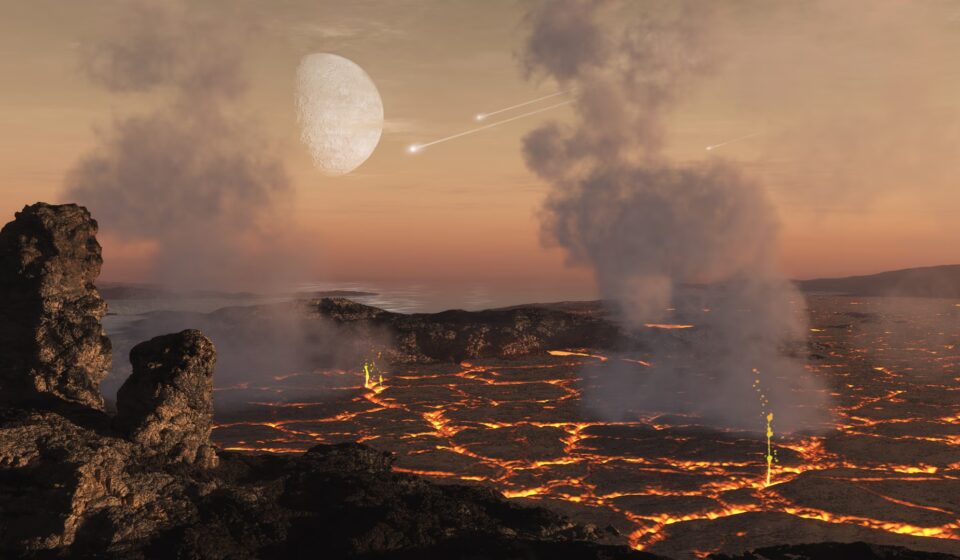

A model of early Earth places the emergence of conditions favorable to RNA-related chemistry in hydrothermal systems around 4.33 billion years ago. This estimate does not date the emergence of life; rather, it indicates when certain environments could have become conducive to prebiotic molecules.
A land still marked by the impacts
Co-led by Oleg Abramov, a researcher at the Planetary Science Institute, the study published in Nature Communications focuses on the Hadean, the first major period in Earth’s history, which spans from approximately 4.5 to 4 billion years ago.
During this period, asteroids and comets frequently struck the young planet. Their impacts heated the crust and could cause episodes of global sterility. But they would also have fractured the rocks, promoting water circulation and the formation of hydrothermal vents in the nascent oceans.
These environments are studied as potential sites for the emergence of life. On Earth, complex communities thrive today around hydrothermal vents, without sunlight and under specific conditions. This does not prove that life originated there, but it makes these environments interesting for studying scenarios of its origins.
The trail of an RNA world
To reconstruct the effect of the bombardment on the crust, the team created a computer model covering the period between 4.5 and 3.5 billion years ago. According to the reported results, conditions remained too unstable to allow the persistence of primitive life forms until approximately 4.4 billion years ago. After that, more stable environments could have developed.
The researchers specifically estimated the evolution of temperatures in hydrothermal systems. Around 4.33 billion years ago, these temperatures would have been compatible with the survival of RNA and other prebiotic molecules, and would have offered favorable potential for a long-lasting chemistry associated with RNA.
This hypothesis, called the « RNA world, » proposes that this molecule preceded DNA and proteins in the early stages of evolution. RNA plays a role in the use of genetic information, and some RNA molecules can also facilitate chemical reactions. According to this theory, it could therefore have participated in both information storage and chemical functions before the emergence of modern biological systems.
A window of possibilities, not a birth date
The date of 4.33 billion years ago should be interpreted with caution. It corresponds to a period when, according to modeling, conditions would have presented a potential for RNA-related chemistry. It does not mean that life appeared precisely at that time, nor that researchers have identified the first living forms.
A later emergence remains possible. Life could have appeared during the Archean eon, the period following the Hadean eon and beginning approximately 4 billion years ago. The geological record does not yet provide a definitive answer: some rocks are the subject of debate regarding the possible presence of traces of very ancient life.
The question is not limited to the origin of RNA. For a living system to function, the emergence of metabolism and compartments, such as cell membranes, capable of containing chemical reactions, must also be explained. The order in which these elements developed and how they evolved together remain unknown.
The study therefore offers a benchmark for understanding when early Earth could have provided favorable conditions for certain chemical processes. It does not establish when life began, but sheds light on one of the possible windows of its emergence.
Source: Latest news from Futura-Espace (www.futura-sciences.com)
Original article: See the original source
Author: Laurent Sacco, Science Journalist