
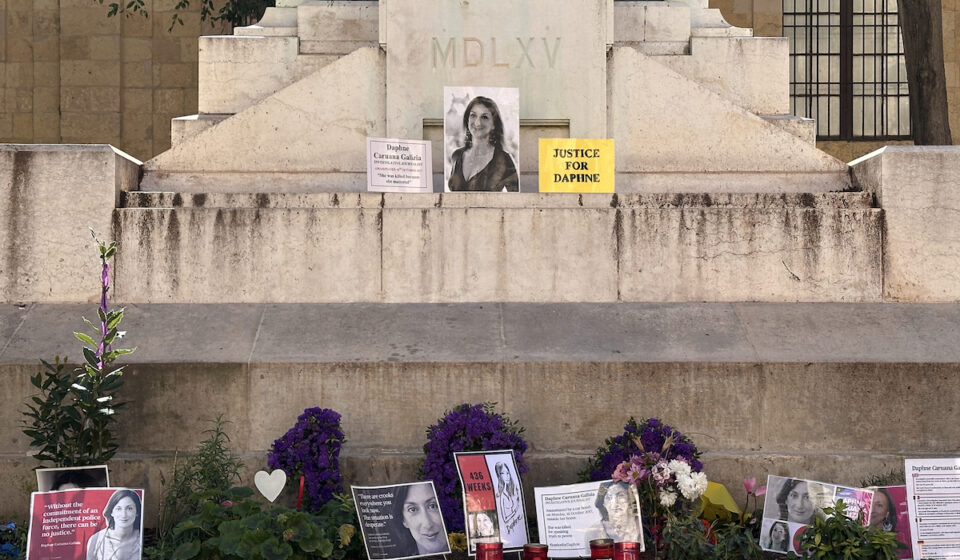

The jury acquitted Yorgen Fenech on September 2nd, after a 55-day trial, in the case of the assassination of Maltese journalist Daphne Caruana Galizia. The verdict, delivered by a vote of eight to one, leaves unanswered the question of who ordered the hit. The prosecution has since officially appealed, and a separate investigation is targeting members of the jury.
An acquittal at the end of a closely watched trial
More than 100 witnesses were heard during the trial, which was described as the longest murder trial in Maltese legal history. After eight hours of deliberation, the jury found that the prosecution had not established Yorgen Fenech’s guilt beyond a reasonable doubt.
Melvin Theuma, a middleman pardoned in 2019, claimed that Fenech had given him the order and the money to recruit the hitmen. The businessman admitted knowing the murder was being planned and paying Theuma money, but maintained he was trying to prevent the assassination. He pointed the finger at Keith Schembri, then chief of staff to Prime Minister Joseph Muscat, as the true mastermind. Schembri rejected these accusations and claimed, on the contrary, that Fenech had practically confessed to the crime.
The defense also highlighted shortcomings in the investigation: Schembri’s phone and computer were never found, and his office at the government headquarters was only searched more than a week after his arrest. Judge Edwina Grima reminded the jurors that the burden of proof rested with the prosecution. Their decision closes the trial at first instance, but not the questions surrounding responsibility for the murder.
A businessman who became a symbol of the links between power and the economy
Yorgen Fenech belongs to an influential Maltese business family. His group, Tumas Group, has interests in real estate, hospitality, and gambling. He also held a 10% stake in the Electrogas consortium, chosen in 2013 to supply the island with electricity.
Daphne Caruana Galizia’s investigations into Electrogas and the offshore company 17 Black led her to Fenech. In February 2017, the journalist established that this entity was linked to financial flows involving, among others, Minister Konrad Mizzi and Keith Schembri. These links were subsequently documented by journalistic investigations, including those by Reuters and the Times of Malta.
For Herman Grech, editor-in-chief of the Times of Malta, the case goes beyond the story of a single man: it highlights the questions raised in Malta about the relationships between economic interests, political leaders, and regulatory institutions. According to him, the country’s small size fosters close ties between these circles, while the polarization between Labour and nationalists complicates the debate on accountability.
A verdict that reignites Maltese divisions
The reaction to the verdict contrasts sharply with the mobilization of 2019. At that time, the emergence of evidence implicating those close to the government sparked mass protests and led to the resignation of Joseph Muscat. Following the acquittal, Herman Grech describes instead a mixture of anger, dismay, and resignation. Daphne Caruana Galizia’s family, for their part, denounced a « denial of justice » and maintained that the responsibility of those who allegedly enabled or protected the murderers remained unresolved.
A public inquiry concluded in 2021 that the state bore some responsibility for the assassination by allowing a climate of impunity to develop. These findings do not establish Fenech’s guilt, as he was acquitted by the jury, but they continue to fuel the debate on institutional failures. The European Federation of Journalists also raises concerns about the polarization of the Maltese media landscape and the lack of trust in the press.
An appeal has been launched and an investigation into the jurors has been initiated.
The procedure has evolved since the announcement of a possible appeal: the Attorney General officially filed his appeal on September 22. This appeal concerns legal issues and alleged irregularities in the conduct of the trial; it is not sufficient to simply contest the jury’s assessment of the facts. The Court of Appeal may reject the appeal or, if it upholds it, order a new trial.
Meanwhile, police arrested and questioned three jurors and the husband of one of them. All four were released on bail. According to police, the investigation concerns public statements some jurors allegedly made before the trial and the oath they took before the hearings began. At this stage, these arrests do not constitute evidence of verdict manipulation.
The verdict thus leaves two distinct questions open: the question of appeals against the acquittal and the question of the identity of the person who ordered the assassination of Daphne Caruana Galizia. It also reignites, in Malta, the debate on the independence of institutions and the protection of journalists.
Source: Voxeurop (voxeurop.eu)
Original article: See the original source
Author: Gian-Paolo Accardo