

High schools blocked: Louis Boyard accuses the government of depriving students of classes

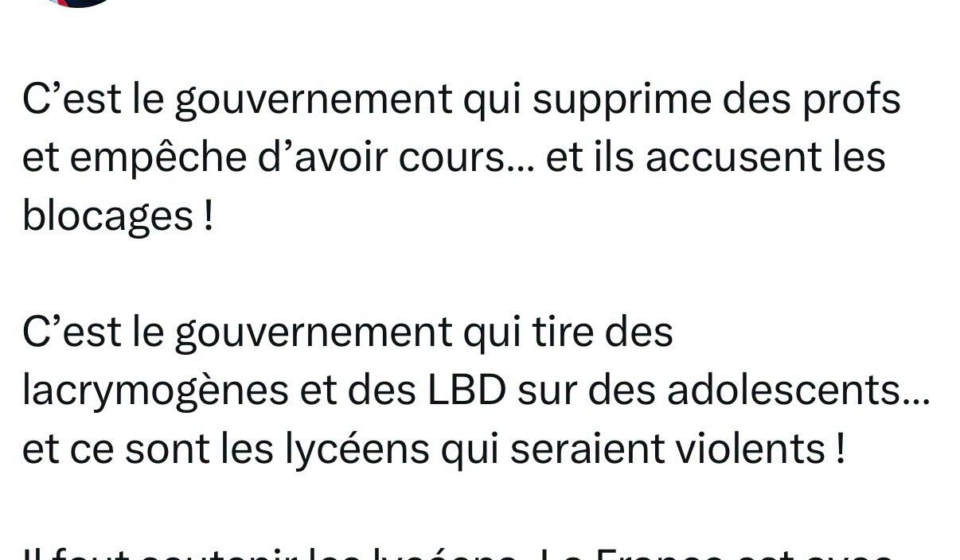
It’s the government that’s cutting teachers and preventing classes. and they’re blaming the blockades! It’s the government that’s firing tear gas and flash-balls at teenagers. and it’s the high school students who are supposedly violent! We must support the high school students. France is with you! Support!
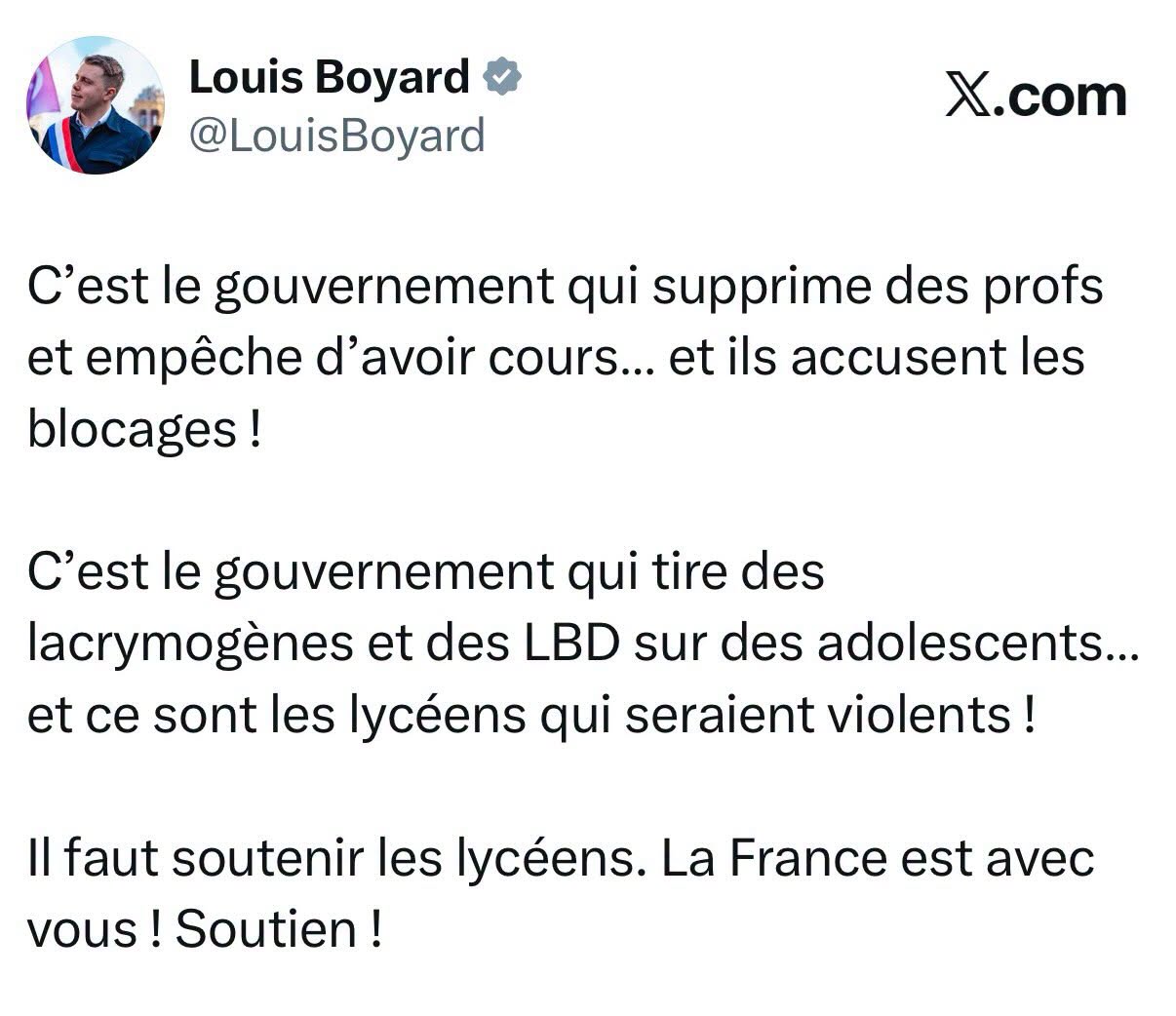
On September 28, 2026, Member of Parliament Louis Boyard defended the protesting high school students, accusing the government of neglecting their education while denouncing the blockades. His post raised two distinct questions: what is known about the teacher shortage cited by the students, and what can be established regarding the use of force during the incidents?
The main fact
Louis Boyard, a member of parliament for Val-de-Marne, supports the protesting high school students. In his message, he blames the government for the difficulties in attending classes and claims that teenagers were targeted with tear gas and rubber bullets. These are political accusations: the post does not specify the school or the intervention that would allow verification of each alleged incident.
What happened
After initial actions on Friday, September 25, the movement spread on Monday the 28th. In a filmed statement, Interior Minister Laurent Nuñez reported that approximately 180 schools were affected that Monday, with 27 complete blockades and 164 arrests. He also announced a preliminary count of about a dozen injured high school students. These figures describe diverse situations, not 180 fully blockaded schools.
The minister described some of the events as « urban violence » and explained that law enforcement intervened in cases of total blockades, in agreement with the head of the school, or in cases of vandalism and violence. His statement alone is insufficient to describe what happened in front of each high school.
The context
The students involved in the protests are denouncing, in particular, teacher absences and overloaded schedules. Their difficulties deserve to be examined on a school-by-school basis. Nationally, however, the 2026 budget does not allow for the simple assertion that the government is « cutting teachers »: the Ministry of National Education is announcing nearly 5,900 additional positions in total compared to 2025, across all categories. An
Key figures
- Approximately 180 establishments were affected by gatherings, blockades, or attempted blockades on September 28, according to Laurent Nuñez.
- 164 arrests and a dozen injured high school students were reported in its provisional report for the same day. An arrest does not constitute a conviction.
- Nearly 5,900 additional jobs are planned for the national education system in 2026 compared to 2025, according to the ministry; this total does not only refer to teachers working directly with students.
What the facts show
In Villeurbanne, during incidents on September 28, security sources cited by Le Progrès reported the use of intermediate force, without being able to establish in their report whether this consisted solely of tear gas. They recorded no injuries related to a LBD (less-lethal defense weapon), contrary to statements from teachers mentioning a student with a head injury. The point therefore remains contested: it is impossible to confirm that an LBD was fired at this student, nor can we dismiss, based solely on this report, any questions about police intervention.
The public debate thus pits two realities against each other, realities that it would be convenient to reduce to a single one. Students are demanding better learning conditions; incidents and injuries have also been reported. The government’s communication regarding student numbers does not address the absences experienced in high schools. Furthermore, support for high school students does not negate the need for precise documentation of shooting allegations.
Key takeaways
Louis Boyard emphasizes missed classes and the police response; the government insists on blockades and violence. To distinguish between these claims, local data on absent teachers and established facts about each intervention are needed. Without this, each side sticks to its own story—and the students are still waiting for answers.
Source: Louis Boyard – Member of Parliament for Val-de-Marne
Original article: See the original source