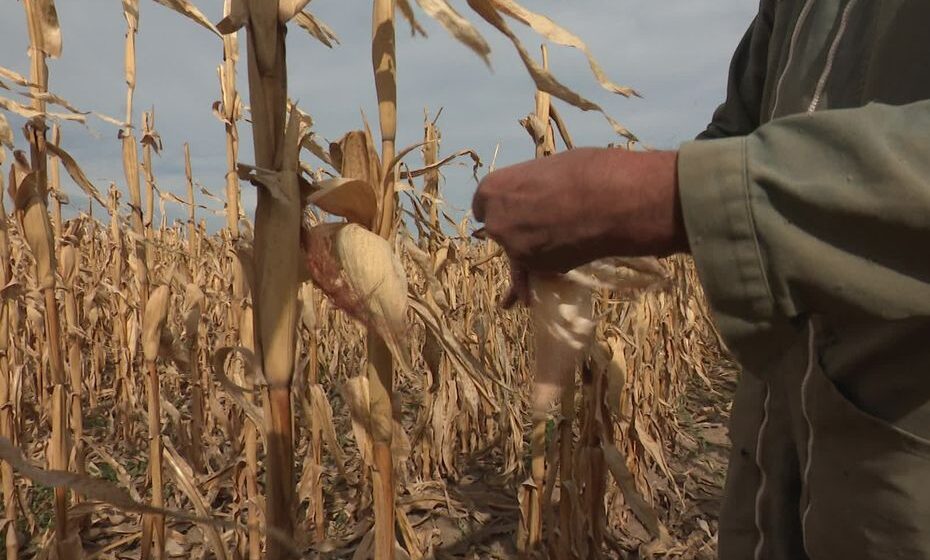

During the summer of 2026, drought severely impacted crops in the Drôme and Ardèche regions. France 3, citing Météo-France data, reports rainfall deficits of 91% in the Drôme and 92% in the Ardèche, describing this summer as the driest in these departments since 1958. These figures reflect past conditions and do not constitute a forecast for the autumn.
Crops penalized in the Drôme
In Chabeuil, grain farmer Philippe Gauthier estimates that wheat yields have decreased by 20 to 30% on irrigated plots. On non-irrigated land, he reports having harvested practically nothing. The lack of water has also made rapeseed sowing very uneven: some areas failed to germinate, while others benefited from sufficient moisture.
On the family farm, his son Vladimir notably left some plots unplowed to preserve soil moisture. However, this method did not prevent the loss of a seedling. The farmers suggest several possible adaptations, such as bringing forward the sowing dates of certain varieties, but emphasize that the solutions differ depending on the crop.
Irrigation: a matter of timing and sharing
For Philippe Gauthier, the difficulty lies not only in the volume of water available: the allocation schedule and its distribution across different regions also play a role. He describes a high degree of uncertainty for farmers when restrictions change during the irrigation season. These remarks reflect his experience and do not, in themselves, describe the rules applicable to all farmers or all watersheds.
Soil drought and water use restrictions are two distinct situations. Prefectural decrees set limits by sector and may change depending on the state of watercourses and groundwater; they do not correspond to the meteorological alert level of Météo-France.
Restrictions to be checked depending on the basin
The latest prefectural reports consulted are not dated September 29th: the Drôme page indicates an update on August 14th, 2026, and the Ardèche prefecture published a statement of restrictions on August 28th. The levels vary depending on the watershed and its uses. To find out the rules applicable to a specific municipality, consult VigiEau and the current prefectural decrees.
The results of a very dry summer are not, in themselves, sufficient to establish a local climate trend or to attribute this episode to climate change. However, Météo-France classifies the summer of 2026, at the national level, as the second driest summer in France since the beginning of the Mediterranean and highlights an exceptional drought in the soil at the national level.
Source: France 3 Regions – Heatwave and heat waves
Original article: See the original source