

Gaza: In August 2025, the IPC did not lower its famine criteria, but applied a different measurement threshold

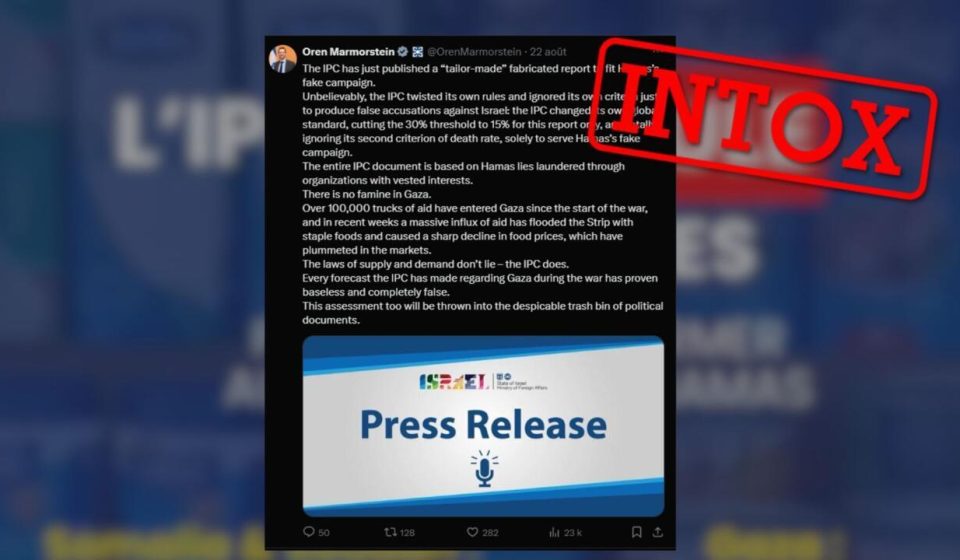
In August 2025, following the declaration of famine in the Gaza Governorate, Israeli officials accused the IPC of having relaxed its criteria. The controversy centers on two malnutrition thresholds, 30% and 15%. However, these correspond to two different methods, both included in the IPC classification framework.
Two thresholds, two methods
On August 22, 2025, the IPC—Integrated Phase Classification of Food Security and Nutrition—declared a famine in the Gaza Governorate. Israeli Foreign Ministry spokesman Oren Marmorstein disputed this assessment. He claimed that the IPC had lowered the threshold for acute malnutrition in children under five from 30% to 15% and had omitted the mortality criterion. The Israeli Foreign Ministry and the Israeli Embassy in France also echoed these criticisms.
The 15% figure does not, however, replace the 30% figure. According to the IPC technical manual, published in 2019, these thresholds relate to two ways of measuring global acute malnutrition in children.
The weight-for-height method assesses a child’s weight in relation to their height. For this method, the threshold associated with famine is 30% of children under five years of age suffering from global acute malnutrition.
The other method, called MUAC, uses mid-upper arm circumference. The corresponding threshold is 15%. This method, recognized by the World Health Organization since 2009, is quicker to perform in the field. It notably allows for the identification of children whose mid-upper arm circumference is less than 11.5 centimeters, a sign of a significant risk of mortality, according to food security expert Adrienne Daudet of the NGO Solidarités International.
An evaluation based on several elements
The malnutrition threshold alone is insufficient to determine whether a situation falls under phase 4—critical food emergency—or phase 5, which corresponds to famine. The IPC framework requires cross-referencing the results of weight-for-height and MUAC methods with available situational information and converging evidence.
In its report of August 22, 2025, the IPC indicated that no recent nutritional surveys in Gaza allowed for a direct comparison of the two methods. The assessment therefore relied on existing studies, including one conducted in the Middle East in 2019. This study suggested that the results obtained by MUAC were generally half those of the weight-height method. The IPC thus adopted the 15% threshold mead by MUAC, which it estimates corresponds to approximately 30% according to the weight-height method.
The report also noted a sharp increase in child malnutrition in the Gaza Governorate: the proportion had reportedly doubled approximately every four weeks in the preceding months. At the time of the report’s publication, the IPC projected that, if this trend continued, more than half of children under five could be affected by the end of September 2025. This projection was based on the situation observed at that time and does not represent a subsequent finding.
The mortality criterion, assessed despite the lack of data
Israeli authorities also argued that the IPC ignored mortality, the famine threshold for which is set at more than two deaths per day per 10,000 people, due to hunger, malnutrition, or related illnesses. The report acknowledges that experts were unable to gather precise mortality figures in Gaza.
The IPC, however, claims to have taken this criterion into account, based on the link between acute malnutrition and increased deaths. The Famine Review Committee (FRC) concluded that mortality thresholds were exceeded in the Gaza Governorate, while indicating that the situation was less critical in other governorates, including Deir al-Balah and Khan Younis.
The Israeli challenge thus juxtaposes two percentages associated with different methods. For the CPI, the 15% threshold is not an improvised reduction: it corresponds to the MUAC, and the famine declaration was based on several elements, despite the absence of direct mortality data and an on-site survey allowing for a comparison of the two methods.
Source: France 24 Observers. Filming, verifying, bearing witness. (f24.my)
Original article: See the original source