

Since the Russian invasion of Ukraine, volunteers from the Baltic and Nordic countries have joined defense organizations that bring together military and civilian personnel. In Estonia, peace activist Ingrid Nielsen is now training with mortars. In Germany, where a new law on military service came into effect in 2026, the debate also focuses on the role society should play in crisis preparedness.
In the Baltic countries, defense mobilizes beyond the army
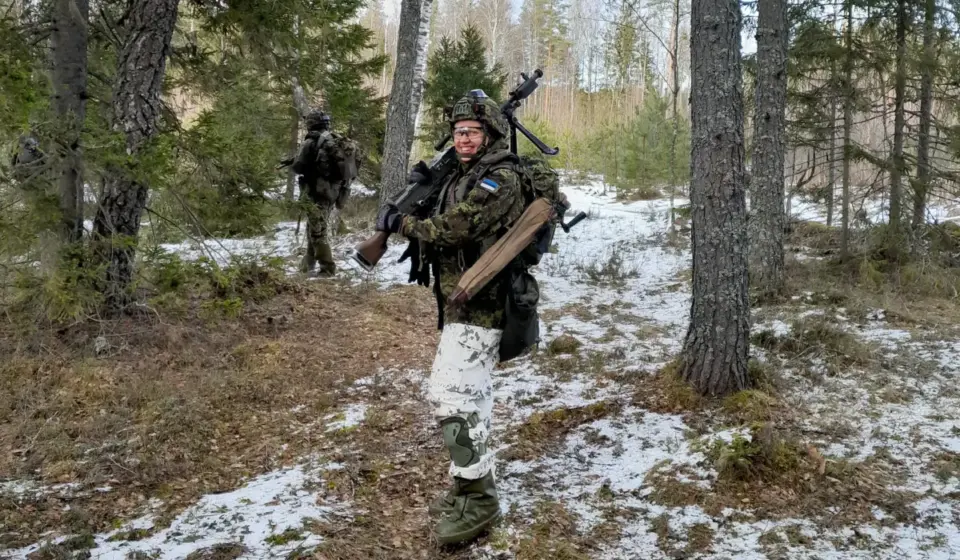
Ingrid Nielsen, a mother of three daughters and environmental activist from Tallinn, never imagined she would one day wear a uniform. On February 24, 2022, the images of Butcha and the accounts of atrocities committed in Ukraine changed her perception of the threat. Today, she participates several times a year in forest exercises, where she learns, among other things, how to load a 120-millimeter mortar.
She is one of thousands of women who have joined Naiskodukaitse, the women’s organization of the Estonian Defence League, since the start of the full-scale invasion. In Latvia, Lithuania, and Finland, volunteer defence organizations are also attracting new members. The principle upheld in these countries is that preparedness is not solely the responsibility of the armed forces.
Estonia, with a population of 1.3 million and 7,000 career military personnel according to figures cited in the report, also relies on reservists, IT specialists, volunteer first responders, teachers, and parents. Citizens participate in network security, youth mentoring, and field exercises. Nele Loorents, from the International Centre for Defence and Security in Tallinn, describes volunteers as a central element of the country’s resilience.
The preparation extends to daily life
Approaches differ from country to country, but they share a common thread: civilians are encouraged to understand their role in a crisis. In Latvia, defense education is part of the school curriculum. In Finland, children learn, among other things, how to identify disinformation, while political leaders visit underground shelters in Helsinki.
Political scientist Oksana Huss, a researcher at the University of Duisburg-Essen, highlights the Ukrainian experience. After the 2014 Revolution of Dignity, citizens organized medical services, logistics, and protection structures. These initiatives then helped support soldiers, displaced people, and the functioning of cities during the 2022 invasion, she explains. According to Huss, this resilience was built from citizen networks, rather than being solely organized by the state.
In Germany, the debate is taking on a new dimension.
Germany is reviewing its military recruitment policy and, more broadly, the role of the population in defense. The Bundestag adopted the Military Service Modernization Act in December 2025, which came into force on January 1, 2026. Since then, 18-year-old men have been required to complete a questionnaire about their motivation and suitability for service; participation is optional for women. From July 1, 2027, men born in 2008 or later will also be required to undergo a medical examination. The system initially relies on voluntary participation. ( bundesregierung.de )
For Florian Constantin Feyerabend, a security expert, civil defense is not limited to soldiers and weapons. However, the German debate remains fraught with disagreements. Peace activist Yannick Kiesel challenges the idea that security is primarily based on rearmament and emphasizes education, social services, and integration. Reserve Lieutenant Colonel Roland Bösker, for his part, advocates for broader participation, which can involve civil defense, hospitals, or government agencies, without necessarily becoming a member of the military.
This preparation also has a logistical dimension. The German operational plan provides for coordination between the military components of the defense forces and the necessary civilian support. In the event of a crisis, Germany’s position in Europe would make it a transit point for Allied reinforcements. The Bundeswehr presents this plan as a framework for cooperation between the armed forces, the authorities, and civilian partners; its detailed content is not public. ( bundeswehr.de )
Comparison with the Nordic and Baltic countries does not mean that Germany will adopt their model. The question that emerges, according to the report, is rather that of the contribution of society as a whole, beyond the military. The shift in mentality remains slow and contested.
Source: Voxeurop (voxeurop.eu)
Original article: See the original source
Author: Adrian Burtin