High school blockades: Macron accuses elected officials of inciting students, LFI responds

On September 30, 2026, from Madrid, Emmanuel Macron condemned the violence surrounding the high school blockades and implicated, without naming them, political figures present with the students. A statement from a mayor affiliated with La France Insoumise provides concrete support for this criticism. However, it is not enough to demonstrate that La France Insoumise is leading the movement or that it is responsible for the violence: this is the crucial difference between confronting statements and assigning responsibility.
The presidential formula and its target
During a press conference with Spanish Prime Minister Pedro Sánchez, Emmanuel Macron said he understood the « anxieties » and « anger » of young people, before asserting that none of them justified violence. He criticized some politicians for going to high schools to « incite students » and reminded everyone that elected officials were not there to « stir up fears and incite the worst. » The president did not name them specifically in the remarks reported by franceinfo.
The events followed a day of protests on Tuesday, September 29, which was also marked by incidents. According to the Interior Ministry’s figures reported by Reuters, 440 arrests were made that day in connection with the demonstrations and blockades. An arrest does not establish guilt or political affiliation ; this figure alone is therefore insufficient to attribute these incidents to a particular party.
What the comparison of statements allows us to say
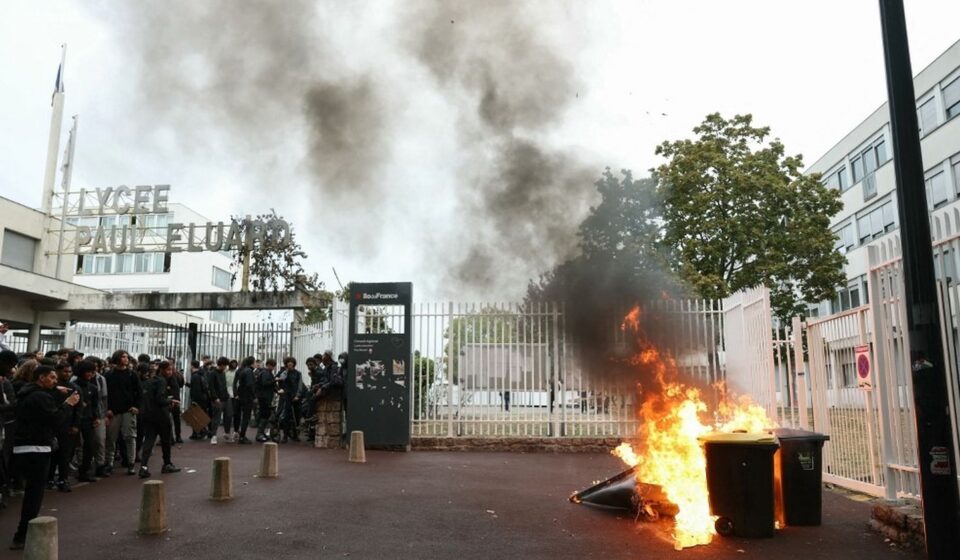
One statement deserves closer examination. In front of the Paul-Éluard high school in Saint-Denis, the mayor, Bally Bagayoko, a member of La France Insoumise (LFI), declared, in an exchange filmed by BFMTV, that violence « can be legitimate. » He was referring to the reaction of young people who, according to him, were confronted by police gunfire. In the same exchange, he added that « whenever possible, it’s better » and warned the young people about the consequences of going too far. The first statement is indeed his; the second is also part of his argument. Neither erasing it nor using it to conclude that all LFI elected officials call for violence would be accurate. The police actions he cites in this exchange are not substantiated by the video of his statement alone.
Jean-Luc Mélenchon and Manuel Bompard, for their part, responded to Macron that La France Insoumise advocated non-violent methods and that its elected officials supported the high school students’ demands. These positions are attributable to their authors: they do not invalidate Bally Bagayoko’s statement, but neither does this statement prove that violence is the guiding principle of the high school movement. The political disagreement is real; the collective implication, however, remains to be demonstrated.
Who is making the demands?
The movement is not simply a duel between the Élysée Palace and La France Insoumise (LFI). In a press release dated September 29, the High School Student Union and the Student Union themselves called for the continuation of the blockades on October 1. They demanded, in particular, better study conditions and denounced overcrowded classrooms and staff shortages. This document establishes the existence of a union call to action and specifies its demands; it does not demonstrate that all high school students share them, nor that all blockades are carried out in the same way.
The teachers’ unions SNES-FSU, SNUEP-FSU, and SNEP-FSU have also published a statement rejecting the false dichotomy between silence on violence and silence on students’ demands. Their text supports these demands, condemns violence against staff and students, and denounces police interventions they deem violent. Each of these grievances requires an examination of the facts; they do not cancel each other out.
The trap of neighboring figures
September 29th was also a day of social action in the national education system. The Ministry published an estimated participation rate of 10.08% in general and technological high schools , within a scope that, at this stage, excluded the academies of Toulouse and Nice. This rate concerns the social movement as mead by the Ministry: it is not a participation rate of high school students in the blockades . To cite it as a mea of their mobilization would be to shift the focus mid-sentence.
Similarly, a school « affected » by an action, a completely blockaded high school, an attempted blockade, and a demonstration in front of its gates do not represent the same situation. Without a detailed assessment based on comparable categories, these counts do not allow for a precise meament of student participation, nor for inferring national political responsibility.
Key takeaways
Macron is responding to identifiable violence and political statements; Bally Bagayoko’s formulation regarding their possible legitimacy does exist, with a nuance that must be preserved. But the documents consulted also show high school and university student organizations formulating their own demands. Supporting a movement, making a questionable statement about violence, and inciting violent acts are three distinct actions. Public debate would benefit from not conflating them into a single accusation—nor from allowing the battle between parties to replace the examination of study conditions and reported incidents.
Main source: franceinfo- Politics (www.franceinfo.fr)
Original article: See the original source
Additional sources
- Ministry of National Education, summary of the social movement of September 29, 2026: See the press release
- Student Union and High School Student Union, appeal published on September 29, 2026: View the appeal
- BFMTV, filmed interview with Bally Bagayoko: Watch the clip
- SNES-FSU, SNUEP-FSU and SNEP-FSU, press release on high school student mobilizations: View the press release